


 by
by 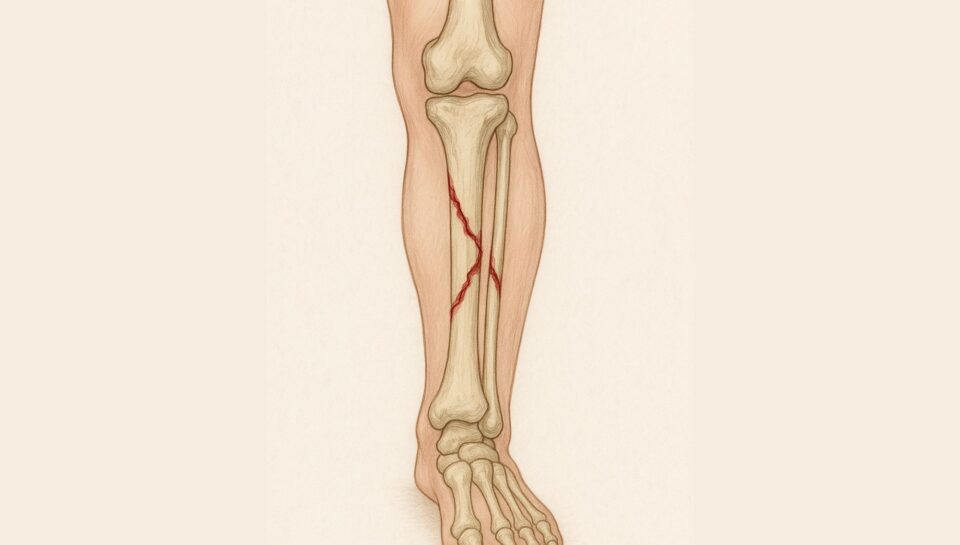
Rehabilitation After a Tibia–Fibula Fracture: A Case from Our Clinic
A 40-year-old male sustained a tibia–fibula fracture while participating in a football match. He was transferred to the hospital, where he underwent closed reduction and intramedullary nailing of the tibia.
*What Is Intramedullary Nailing?
Intramedullary nailing is a stabilization technique in which a metal rod is inserted inside the fractured bone. It is often preferred by many surgeons over other fixation methods due to its minimally invasive nature and the possibility of early mobilization of the affected limb.
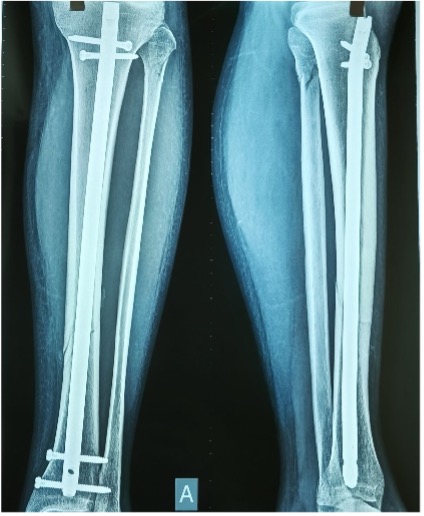
| X-ray imaging one month after the injury. |
The patient visited our clinic one month post-surgery with instructions for partial weight-bearing, ambulation using two axillary crutches, reduced range of motion in both the ankle and knee joints, and decreased muscle strength throughout the lower limb.
During the initial phase of rehabilitation, our goals were pain relief, edema management, and restoration of joint range of motion—always in accordance with the physicians’ guidelines. Particular emphasis was placed on the gradual loading of the affected limb and the achievement of independent walking.
*What Is Independent Walking?
Independent walking refers to ambulation without assistive devices. It is achieved through gait re-education and offers multiple benefits for both the patient and the overall treatment outcome. It promotes self-sufficiency and increased physical activity, which in turn supports psychological well-being. It also allows for the progressive introduction of more demanding exercises that are essential for full rehabilitation and return to daily life.
After achieving full weight-bearing capacity, our focus shifted to increasing muscle strength. Early-stage strengthening involves controlled execution of isolated joint movements (e.g., knee flexion, hip extension), with strong emphasis on the simultaneous activation of multiple muscle groups. Rehabilitation always includes multi-joint, functional movements—those that restore real-life abilities and simulate daily demands (e.g., climbing stairs, getting in and out of a car, cycling).
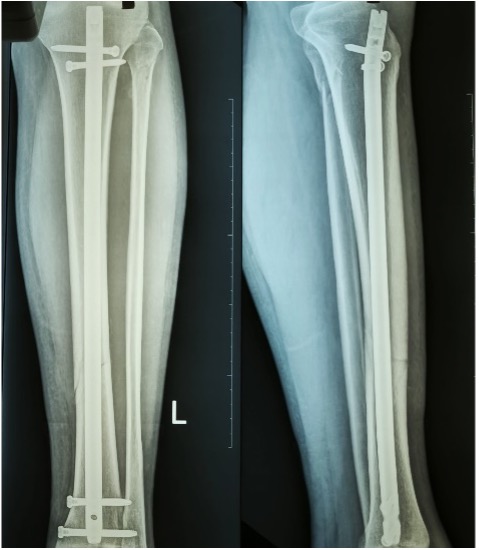
| X-ray imaging three weeks after the initiation of physiotherapy treatment. |
The final phase of rehabilitation for any lower limb injury always includes balance and proprioception training, as these are crucial for functional recovery and prevention of future injuries.
*What Is Proprioception and How Does It Contribute to Balance?
Proprioception is the brain’s ability to constantly recognize the position of our body parts in space. It is closely linked to balance, as it enables the brain to adjust posture and movement according to environmental conditions (e.g., walking on uneven ground, wet surfaces, or navigating obstacles).
Upon completing his treatment program, our patient left our physiotherapy clinic fully functional, having returned to work and equipped with instructions for continuing his rehabilitation independently. We remain by our patients’ side throughout and beyond their treatment journey—offering clarification, guidance, and support toward a pain-free daily life.
Rafaela Agagioti
Physiotherapist
